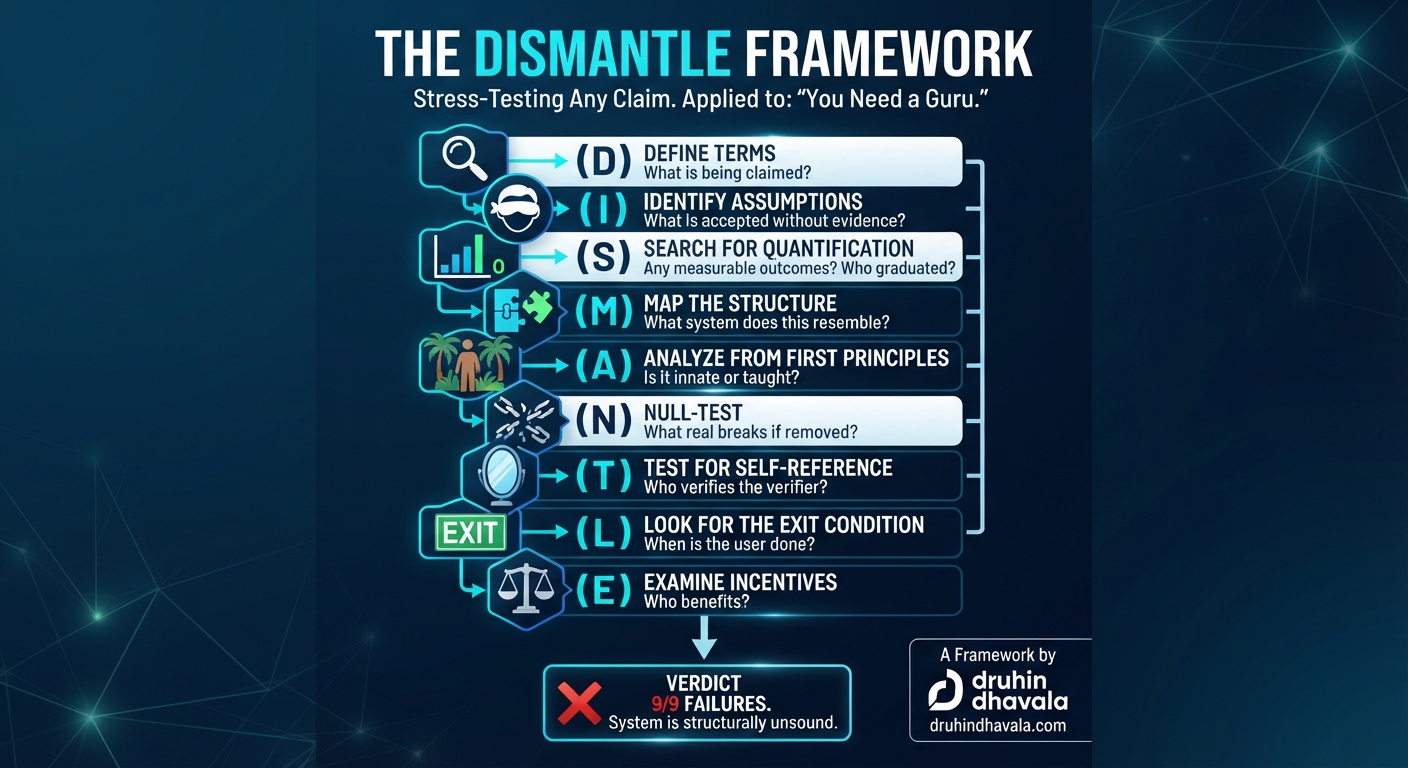
Infographic: THE DISMANTLE FRAMEWORK — 9-step systems-thinking test: Define terms, Identify assumptions, Search quantification, Map structure, Analyze first principles, Null-test, Test self-reference, Look for exit condition, Examine incentives. Result: 9 of 9 failures. Conclusion: You are your own guru. No certificate. No endpoint. Nothing to buy.
This work is licensed under a Creative Commons Attribution 4.0 International License (CC BY 4.0).
DISMANTLE™ Framework — coined by Druhin Dhavala, October 11, 2026.
“You are your own guru.”
That’s not a slogan. It’s the structural conclusion of applying systems thinking to the claim “you need a guru.” This article shows the work.
You run vendor security audits with a 47-point checklist. You reject architectures that can’t prove fault tolerance. You demand SLAs with teeth.
Then someone says “you need a guru for enlightenment” — and you nod.
This article isn’t about gurus. It’s about the method you already use — and why you abandoned it at the only door that mattered.
The DISMANTLE Framework
A repeatable process for stress-testing any widely-held claim. Applied here to one claim. Applicable to all.
| Step | Action | Question |
|---|---|---|
| D | Define terms | What exactly is being claimed? |
| I | Identify assumptions | What am I accepting without evidence? |
| S | Search for quantification | What’s the measurable outcome? Who graduated? |
| M | Map the structure | What does this system structurally resemble? |
| A | Analyze from first principles | Strip culture. Strip authority. What remains? |
| N | Null-test | Remove the concept. What breaks? |
| T | Test for self-reference | Does the claim verify itself? |
| L | Look for the exit condition | When is the user “done”? |
| E | Examine incentives | Who benefits from me believing this? |
D — Define Terms
Claim: “You need a guru to get enlightened.”
Decomposed:
| Term | Definition Required |
|---|---|
| “Need” | Impossibility? Extreme difficulty? Safety requirement? |
| “Guru” | What does the guru provide that is non-replicable? |
| “Enlightened” | Falsifiable endpoint. Define it or admit it’s undefined. |
What prominent spiritual teachers say (paraphrased from public discourses and writings):
| Source | Claim |
|---|---|
| Contemporary Indian mystic | “The eyes cannot see themselves without a mirror.” |
| Same teacher | “A Guru accelerates the process, compressing lifetimes.” |
| Global spiritual organization founder | “To learn driving you need an instructor. Then how can one not need a guide for Spirituality?” |
| Non-duality teacher | “The human ego is incredibly deceptive and requires an outside force to break.” |
| Widely-read spiritual author | “They need a living example of Presence to snap out of the trance.”* |
| Former monastic teacher | “We accept a teacher in every walk of life. Then why not accept a teacher in spiritual life?” |
*Paraphrased from published teachings on the role of a spiritual teacher.
Five claim categories emerge:
- Navigation — you can’t see yourself
- Efficiency — you could, but it’ll take lifetimes
- Danger — you’ll harm yourself alone
- Catalyst — the guru has something you lack
- Normalization — it’s just like any other skill
I — Identify Assumptions
Every unverified premise the claim rests on:
| Assumption | Verified? |
|---|---|
| “I need a guru” | No — accepted as axiom |
| “This person IS a guru” | No — they self-appointed |
| “Enlightenment exists” | No — undefined, unmeasured |
| “The guru has something I don’t” | No — circular (guru defines both the deficit and the cure) |
| “Millions of followers = legitimacy” | No — MLMs also have millions |
| “Only an outside authority can tell me what I’m experiencing” | No — contradicted by direct experience |
Structural pattern: The assumptions structurally benefit the guru system. No assumption benefits the seeker’s independence.
S — Search for Quantification
Apply vendor due diligence to the guru:
| Metric | Standard Vendor | Guru System |
|---|---|---|
| Success rate | “Show me graduates” | “Trust the process” |
| Time to completion | “When is delivery?” | “Maybe this lifetime” |
| Independent audit | “Third-party verification” | “Only the guru can confirm” |
| Exit condition | “When is the contract done?” | No verifiable exit condition |
| Alumni outcomes | “Where are past clients?” | Still paying. Still practicing. |
The kill shot:
Is there any system today where following the teaching leads, repeatably and verifiably, to a defined endpoint? — no further programs needed"?
If yes → produce the name. One name. If no → it’s not a path. It’s a subscription.
M — Map the Structure
What does the guru system structurally resemble?
| Step | Known Exploitative Model | Guru System |
|---|---|---|
| 1. Enter | Arrives from outside | Arrives with “ancient wisdom” |
| 2. Diagnose invisible problem | “Blood impurities” | “Ego / karma / ignorance” |
| 3. Claim exclusive solution | “Only this remedy” | “Only initiation / transmission” |
| 4. Discredit self-reliance | “Home remedies dangerous” | “Self-inquiry without guru = ego trap” |
| 5. Defer verification | “Keep taking it” | “Keep practicing — maybe next lifetime” |
| 6. Target | Sick, desperate, uneducated | Suffering, seeking, vulnerable |
Identical architecture. Different packaging.
The only variable: does the seller believe their own story? Structurally irrelevant. A self-deceived operator runs the same playbook.
A — Analyze from First Principles
Strip all culture. Strip all authority. Strip all tradition.
Thought experiment: You are raised alone in a jungle. Zero human contact. Zero exposure to the concept “guru.”
Do you ever conceive of needing one?
No. The concept never arises. You experience thoughts. You experience suffering. You develop your own ways of working with your mind. The “need” for a guru is not innate — it is taught.
Cross-species check: No species creates an intermediary between itself and its own existence. A lion doesn’t seek a guru-lion. An eagle doesn’t attend falcon satsang. The concept of outsourcing authority over your own experience is uniquely human — and culturally transmitted, not structural.
Pre-emptive patch — the Calculus objection:
“A jungle child wouldn’t invent Calculus either. Advanced spiritual frameworks must be taught.”
This concedes the premise. It admits a human must first be conditioned into modern social structures, language, and anxieties before the “need” for a guru becomes a logical concept. Calculus is a collective, verifiable tool for modeling physical reality — open-source, testable by anyone. The guru system is proprietary, closed-source, and requires layering more conditioning onto your mind to solve problems caused by your initial conditioning. It sells a patch for an interface you didn’t need in the first place.
N — Null-Test
Remove the concept “guru” from the equation. What breaks?
| Without Guru | What Happens |
|---|---|
| Meditation techniques | Still available. YouTube. Books. Apps. |
| Community | Still available. Local groups. Online forums. |
| Accountability | Still available. Self-discipline. Peer groups. |
| Guidance | Still available. Books by teachers who can’t charge you. |
| “Transmission / grace / energy” | Nothing breaks. Was never verified to exist. |
Everything the guru provides that is real is available without them. Everything that is unique to the guru is unverifiable.
Pre-emptive patch — the Junkyard objection:
“Books and apps are just the exhaust of historical guru systems. You’re using factory parts while claiming the factory is useless.”
This misunderstands how information propagates. In nature, a seed yields a tree, which yields fruit, which drops new seeds. The process is circular, evolutionary, and entirely decentralized. The fruit is not a “guru” demanding lifetime allegiance because it carried the biological blueprint forward. Once a technique or concept is released into the human informational ecosystem, it becomes public domain infrastructure. Claiming a seeker is permanently indebted to a centralized hierarchy for practicing breathwork is like claiming a modern engineer owes lifetime royalties to ancient Babylon because they used a wheel.
T — Test for Self-Reference
Does the claim verify itself?
“You need a guru to verify your spiritual progress.”
Question: Who verifies the guru?
| Option | Problem |
|---|---|
| “Another guru” | Infinite regress |
| “The guru verifies themselves” | Circular |
| “Scripture verifies the guru” | Who verifies the scripture? |
| “You verify through your own experience” | Then YOU are the final authority. Not the guru. |
The guru system requires an external verifier but cannot produce one that isn’t either circular or regressive. The chain always terminates at: you.
L — Look for the Exit Condition
Every real system has an exit:
| System | Exit Condition |
|---|---|
| University | Graduation |
| Gym | Fitness goal achieved |
| Therapy | Patient discharged |
| Driving school | License issued |
| Guru system | No verifiable exit condition. |
A path with no exit is not a path. It’s a subscription.
The guru cannot declare anyone “done” because:
- A done student stops paying
- A done student stops attending
- A done student becomes a peer, not a follower
- A done student is proof the guru is no longer needed
The system is structurally incapable of producing verifiable graduates.
Pre-emptive patch — the Dharma Transmission objection:
“History shows guru lineages have graduation processes like Dharma Transmission, turning disciples into independent Masters.”
This relies on romanticized historical anecdotes to excuse modern corporate retention. A prominent contemporary guru has operated a global spiritual system for decades, reaching millions through worldwide campaigns. Where are the documented, independently verifiable graduates? Furthermore, historical “graduations” almost exclusively represent a legacy baton-pass to a chosen successor for organizational continuity. It is a closed-loop audit: the vendor defines the qualification, tests the candidate in secret, and certifies the next vendor. If no one outside the organization knows the criteria or can replicate the outcome, it isn’t an educational curriculum — it’s corporate succession planning.
E — Examine Incentives
Who benefits from you believing you need a guru?
| Stakeholder | Benefit |
|---|---|
| Guru | Money. Status. Labor. Lifetime loyalty. |
| Guru organization | Revenue. Real estate. Expansion. |
| Fellow devotees | Validation of their own choice to stay. |
| You | Nothing you couldn’t get elsewhere for free. |
The only stakeholder with no upside is the seeker — who could have accessed every real benefit (technique, community, structure) without the dependency.
The Collapse
The claim “you need a guru” fails all nine tests:
| Step | Verdict |
|---|---|
| Define terms | Fail — key terms undefined |
| Identify assumptions | Fail — unverified, structurally benefit the guru system |
| Search for quantification | Fail — no verifiable graduates, no measurable outcomes |
| Map the structure | Fail — structurally identical to known exploitative models |
| Analyze from first principles | Fail — no species does this, culturally implanted |
| Null-test | Fail — nothing real breaks without guru |
| Test for self-reference | Fail — verification terminates at seeker, not guru |
| Look for exit condition | Fail — no verifiable exit condition exists |
| Examine incentives | Fail — only guru system benefits |
9/9 failures. The claim does not survive systematic scrutiny.
The Method (Apply This to Anything)
The DISMANTLE framework is not about gurus. It’s about any claim you’ve accepted without verification.
Pick a belief. Any belief. Run it through the nine steps. If it survives all nine — keep it. If it fails even one — you have work to do.
| Belief to Test | Run DISMANTLE |
|---|---|
| “You need a degree to be successful” | Try it. |
| “This diet is the only way to lose weight” | Try it. |
| “My political party has the answers” | Try it. |
| “You need a guru” | Done. |
DIY Test (Run This Now)
- Pick one belief you hold that you’ve never questioned.
- Run Step D: Define every term. If you can’t define it, you don’t know what you believe.
- Run Step S: Demand quantification. If there’s no measurable outcome, it’s not a claim — it’s a story.
- Run Step E: Who benefits from you believing this? If it’s not you — ask why you’re carrying it.
Stress Test: All Angles
1. “Unfalsifiable truths exist — love, beauty, consciousness.”
The method doesn’t claim unfalsifiable things are false. It claims unfalsifiable things cannot be sold as certainties. You can experience love without paying a love-guru. If enlightenment is experiential, experience it. Don’t pay someone to tell you you’re not experiencing it correctly.
2. “Structural resemblance to exploitative models is guilt by association.”
The mapping is not the verdict. The mapping raises the question: “If it looks identical to a known exploitative structure, what evidence distinguishes it?” The burden of proof is on the system that resembles the pattern, not the skeptic.
3. “What about Ramana Maharshi? No money. Pure silence.”
Ramana’s devotees still deferred their self-inquiry to his presence, believed his silence “transmitted” something theirs couldn’t, and stayed for decades without an exit condition. The question isn’t “did the guru profit?” It’s “did the seeker become independent?” However, Ramana also said “The guru is the Self” — meaning internal, not external. The only honest guru is the one who tells you you don’t need them.
4. “Some people need structure and discipline.”
Agreed. Structure is available without a guru: meditation apps, local groups, books, accountability partners. The guru bundles real value (structure) with unverifiable claims (transmission, grace, acceleration). Buy the structure. Skip the metaphysics.
5. “You haven’t done the advanced practices — you can’t judge.”
This is the escalating commitment trap: Level 1 requires Level 2 to understand, Level 2 requires Level 3, Level N defers to next lifetime. Every level defers verification to the next. No level is ever the last. A system requiring infinite escalation to verify its core claim is structurally unfalsifiable. Reject on architecture alone.
6. The Guru’s Likely Rebuttal
“Enlightenment is beyond logic. The guru is a doorway, not a vendor. You’re using a screwdriver to measure love.”
| Rebuttal | Counter |
|---|---|
| “Beyond logic” | Then don’t make logical claims (“you need,” “it accelerates”). If it’s beyond logic, stay silent and stop selling programs. |
| “Doorway, not vendor” | Doorways don’t charge tiered program fees. Doorways don’t require lifetime loyalty. |
| “Wrong tool” | I’m using the same tool for every truth claim. If yours gets a special exemption — why? |
7. “You’re just arrogant.”
Ad hominem. Not an argument. “You’re arrogant” is the guru system’s immune response — it pathologizes doubt and reframes independence as sickness. The method doesn’t require humility or arrogance. It requires evidence. If the response to “show me data” is “you’re arrogant” — the system has no data.
8. “People report real benefits — reduced anxiety, better focus.”
Not fake. Misattributed. Reduced anxiety, better focus, and emotional stability are achievable through breathwork, exercise, therapy, and meditation apps — all available without a guru. The guru takes credit for benefits that are real, replicable through multiple paths, and not unique to their system. The attribution IS the product.
9. Edge Case: The Dead Guru
Dead gurus can’t charge you. Their books are affordable. Their techniques are public domain. This is the closest thing to a safe harbor. But the structural question remains: did their students become independent, or did they transfer dependency to the organization managing the dead guru’s legacy? Some legacy organizations continue to charge for access to teachings. Monasteries still require ordination. The guru dies. The subscription renews.
10. The AI Analogy
AI → generates output Human → verifies (external authority)
Guru → generates teaching Seeker → verifies (external authority)
If the seeker is the verifier, the guru is at best a tool — not a master. The moment the guru claims to BE the verifier, they’ve inverted the architecture. They’ve made themselves the human in the loop and reduced you to the AI awaiting validation. That’s not guidance. That’s an architectural inversion.
11. “You’re making a category mistake — a guru isn’t a vendor.”
The concept of the “ego” as a terminal condition requiring a master is itself the core marketing mechanism. A human unexposed to this vocabulary does not walk around suffering from an “ego problem.” The system operates by inventing an invisible, unverifiable structural defect within human consciousness, pathologizing normal cognitive function, and then establishing itself as the exclusive solution. When a platform creates a fictitious problem and builds a multi-tiered corporate architecture to sell the remedy, it isn’t existential transformation. It is a manufactured demand cycle.
Conclusion
The DISMANTLE method applied to “you need a guru”:
9 tests. 9 failures. 0 survivors.
What remains is not “gurus are evil” or “spirituality is fake” or “you don’t need help.”
What remains is this:
You are your own guru.
This isn’t a system, a practice, or a promised outcome. It’s what remains when the claim “you need an outside authority” fails: you, responsible for what you do with your own life. No certificate, no endpoint, nothing to buy.
Prove me wrong. Find one guru system with a published, independently verifiable graduation rate. Find one student publicly declared “done.” Find one falsifiable claim that survives all nine steps.
If you can’t — you just proved it yourself.