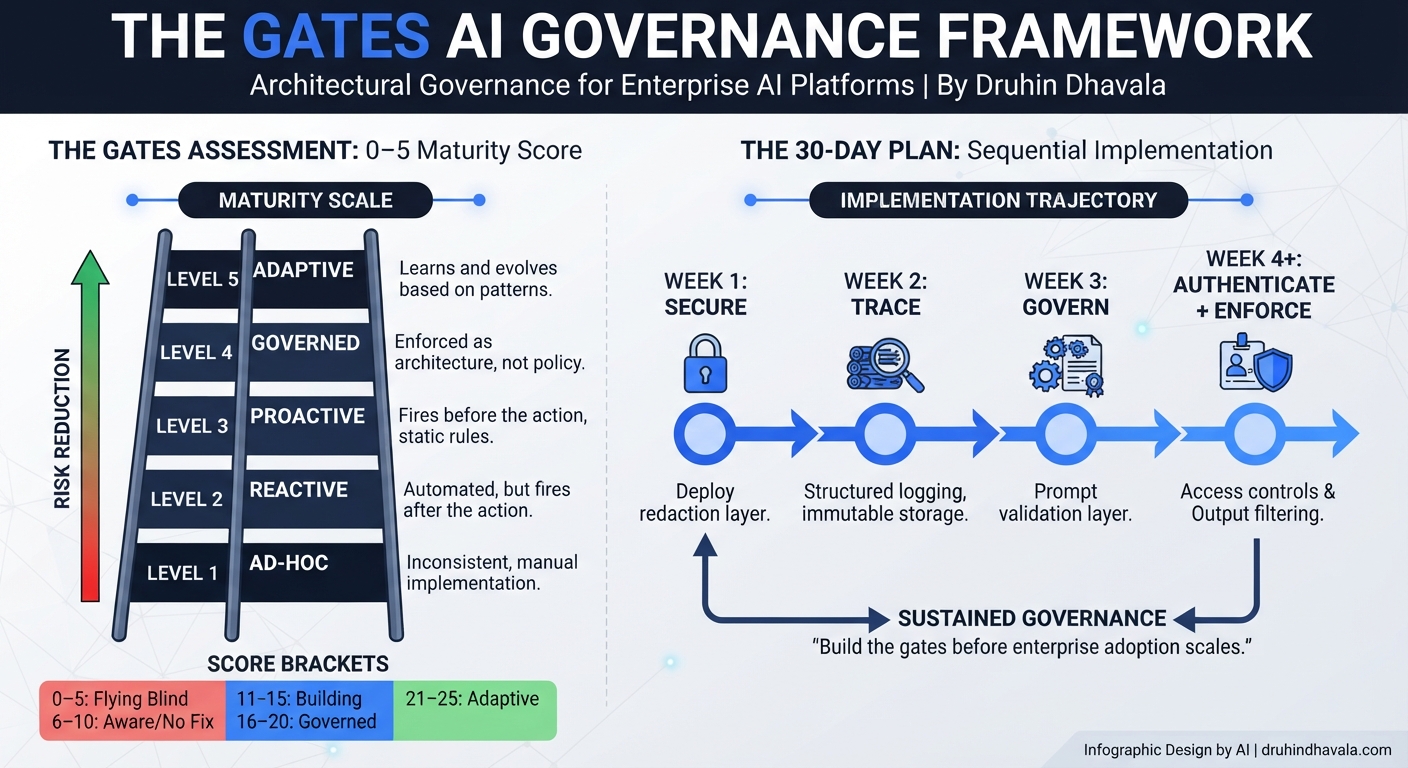
The infographic above summarizes the GATES framework: five gates (Secure, Govern, Authenticate, Trace, Enforce), a 0-5 maturity score for each gate, a 30-day implementation plan starting with Week 1: Secure, and the trajectory from ad-hoc governance to sustained governance.
This work is licensed under a Creative Commons Attribution 4.0 International License (CC BY 4.0).
GATES™ AI Governance Framework — coined by Druhin Dhavala, October 10, 2026.
I’m not an AI expert. I want to start there because LinkedIn is full of people who sound like AI experts and have never built anything. I’m not that person, and I don’t intend to become one.
I’m a platform and governance veteran. I’ve spent 12+ years building enterprise API platforms — the kind that handle billions in annual transaction volume, the kind that fail at 2 AM when nobody’s watching, the kind where governance deferred becomes governance denied.
I don’t have AI scars. Nobody does — the space is too new. But I have API scars. And when I look at how organizations are adopting AI, I see the same patterns I watched play out in API programs a decade ago. The same deferred decisions. The same “we’ll fix it in phase 2.” The same assumption that governance is documentation, not architecture.
GATES is my attempt to name the gates before you hit them — not because I know AI, but because I know what happens when governance is deferred. The framework is mine. The scars are mine. The AI parallel is what I see, clearly and widely, from a decade of watching the same mistakes compound.
If you’re an AI expert, this article will feel incomplete. That’s intentional. GATES is the governance layer. The implementation is yours. I’m not here to teach you how to build RAG pipelines or fine-tune models. I’m here to make sure you don’t ship them without gates.
This article is the third in a series.
The first documented my API gateway journey — 12+ years of scars from building enterprise API platforms, migrating legacy systems, and watching governance deferred become governance denied.
The second, written eight months ago, argued that AI governance must be architectural — that the AI Gateway would become the control plane for enterprise AI, the same way the API Gateway became the control plane for enterprise APIs.
That article diagnosed. This one prescribes.
The API Scar That Made Me Write This Five years ago, I was standing in a war room at 2 AM watching an API gateway fail under load. The root cause wasn’t the gateway — it was the governance decisions we’d deferred to “phase 2.” No consistent rate limiting across teams. No standardized authentication patterns. No unified observability. Every team had built their own version of governance, and none of them talked to each other.
We recovered. We shipped fixes. We learned.
But the lesson stuck: governance deferred is governance denied. And when I look at how organizations are adopting AI — shipping Copilot integrations, building RAG pipelines, deploying internal LLM assistants — I see the same deferral happening. The same “we’ll add governance later.” The same assumption that the system will tolerate the delay.
It won’t. AI systems compound faster than API systems did. The window to build governance correctly is before adoption scales, not after.
GATES is the framework I wish someone had handed me before that 2 AM war room. It’s five functions every AI Gateway needs to enforce, in the order they need to execute. It’s not a product. It’s not a vendor pitch. It’s the pattern I see, drawn from API scars, applied to AI by analogy.
- A user prompt arrives.
- Sensitive data must be redacted before anything else touches it.
- The prompt must be validated against policy.
- Access must be confirmed.
- The interaction must be logged.
- The output must be filtered before the user sees it. That’s six steps. But “redact” and “validate” can be folded into a single gate if you architect them as a pipeline. So can “log” and “filter” if your observability layer captures both. Which leaves five gates — each one a distinct function, each one a distinct failure mode if missing.
GATES.
S — Secure: Redact Before You Regret Every prompt is a potential data leak.
I learned this during an API gateway migration when a partner integration started sending PII in query parameters — not because they were malicious, but because nobody had told them not to. We caught it in a log review three months later. Three months of PII flowing through our gateway, unredacted, unaudited.
That was APIs. With AI, the surface area is larger. Employees paste customer data into AI assistants to “summarize” it. Developers paste proprietary code into AI tools to “refactor” it. Analysts paste financial models into AI to “explain” them. Every one of those pastes is a potential exfiltration event — and most organizations have zero visibility into any of them.
Secure is the first gate because it has to be. You cannot govern what you cannot see, and you cannot see sensitive data if it’s already been echoed back to a model provider in plaintext.
What this looks like in practice:
- Real-time detection of PII, PHI, PCI, and proprietary IP patterns
- Redaction or tokenization before the prompt leaves your perimeter
- Detection that goes beyond regex — pattern-based, context-aware, whatever the AI implementation requires
- Fail-closed defaults (if you’re not sure, redact)
- The maturity ladder here is steep. Level 1 is regex. Level 5 is context-aware detection that understands that “the project I’m working on” might refer to a confidential initiative. Most organizations are at Level 1. Some are at Level 0 — no redaction at all, just prayers.
What fails without it: Data exfiltration. Compliance violations. The kind of incident that ends up on the front page of The Register.
G — Govern: Policy Before Processing In the API world, I watched organizations ship hundreds of APIs with no consistent design standards. Every team had its own naming conventions, its own error formats, its own authentication patterns. The result was an API ecosystem that looked like a city built without zoning laws — technically functional, operationally chaotic.
AI is worse. Because AI doesn’t just have inconsistent interfaces. It has inconsistent behavior. The same prompt can produce different outputs depending on the model version, the temperature setting, the system prompt, the retrieval context, and the phase of the moon. Without governance, you’re not building a system. You’re running a lottery.
Govern is the gate that enforces consistency. It validates prompts against enterprise policy before they reach the model. It enforces prompt versioning and lifecycle management. It standardizes retrieval patterns across RAG pipelines so that the same query produces the same context window regardless of which team issued it.
What this looks like in practice:
- A policy engine that validates prompts against rules (no PII, no off-topic queries, no jailbreak patterns)
- Prompt templates with version control and deprecation policies
- Retrieval standards that enforce which data sources can be used for which use cases
- Model selection policies (which model for which task, which fallback when the primary is down)
- The maturity ladder: Level 1 is a wiki page nobody reads. Level 5 is an automated policy engine that evaluates every prompt in real time and rejects violations before they cost you anything.
What fails without it: Inconsistent outputs. Policy violations that compound over time. The slow erosion of trust in AI systems because “sometimes it works, sometimes it doesn’t.”
A — Authenticate: Access Before Invocation Not everyone should access every model. Not everyone should access every data source. Not everyone should be able to invoke every capability.
I learned this during an API gateway evaluation when we discovered that one of the platforms we’d tested had a default configuration that allowed any authenticated user to invoke any API — including admin endpoints. The vendor’s documentation mentioned it. Nobody on our team had read that page. We caught it in a chaos test. If we hadn’t, it would have shipped to production.
That was APIs. With AI, the stakes are higher. A user with access to a model trained on proprietary data can extract that data through prompt engineering. A user with access to a RAG pipeline connected to financial systems can query revenue figures they shouldn’t see. A user with access to an agent that can take actions — send emails, modify records, execute transactions — can do real damage if their access isn’t scoped correctly.
Authenticate is the gate that enforces access boundaries. It confirms who is making the request, what they’re allowed to do, and what data they’re allowed to touch. It applies role-based and context-based controls — not just “is this user authenticated?” but “is this user authenticated for this specific action, on this specific data, at this specific time?”
What this looks like in practice:
- RBAC and ABAC enforcement at the gateway layer
- Context-aware access (location, device, time of day, data sensitivity)
- Scoped tokens for model invocations (not blanket API keys)
- Just-in-time access for high-risk operations
- The maturity ladder: Level 1 is shared accounts. Level 5 is dynamic, context-aware access that adapts to risk signals in real time.
What fails without it: Unauthorized access. Privilege escalation. The kind of breach that starts with “I thought they only had read access.”
T — Trace: Log Everything, Always I cannot tell you how many times I’ve been asked, after an incident, “What happened?” And how many times the answer was “We don’t know — we don’t have the logs.”
This is not acceptable. It was not acceptable in the API world. It is catastrophically unacceptable in the AI world, where the same input can produce different outputs, where the same model can behave differently across versions, and where the regulatory environment is moving faster than any technology governance framework in recent memory.
Trace is the gate that creates the audit trail. It logs every interaction — prompt, policy decision, model invocation, retrieval context, output, user, timestamp, cost. It makes the system explainable after the fact. It makes compliance demonstrable. It makes debugging possible.
What this looks like in practice:
- Structured logging of every prompt and response
- Immutable storage (you can’t tamper with audit logs)
- Query interface for incident response and compliance audits
- Lineage tracking (which data influenced which output)
- Cost telemetry (which prompts cost how much, to which model, for which user)
- The maturity ladder: Level 1 is basic logs that nobody queries. Level 5 is full lineage and explainability — you can trace any output back to the exact prompt, model version, retrieval context, and policy decision that produced it.
What fails without it: Inability to audit. Inability to debug. Inability to answer the regulator when they ask “why did your model produce this output about this person?”
E — Enforce: Filter Before Delivery Models hallucinate. Models leak. Models produce outputs that violate policy, brand guidelines, or basic human decency.
I watched an API gateway produce a response that included stack traces from an internal service — not because the API was designed to do that, but because an error handler had been misconfigured and nobody had tested the failure path. That stack trace contained internal IP addresses, service names, and a hint at a vulnerability we hadn’t patched. It went out to a partner. We found out three weeks later.
That was an error path. With AI, the error paths are wider. Every prompt is a potential failure mode. Every output is a potential policy violation. And unlike APIs, where you can validate a response against a schema, AI outputs are probabilistic — you can’t schema-validate a hallucination.
Enforce is the gate that filters outputs before they reach the user. It applies safety controls — toxicity classifiers, PII detectors, brand voice validators, factual consistency checks. It catches what the model got wrong before the user sees it.
What this looks like in practice:
- Output classification (toxicity, PII, brand voice, factual consistency)
- Human-in-the-loop for high-stakes outputs
- Automated redaction or regeneration when outputs fail checks
- Escalation paths for outputs that can’t be auto-resolved
- The maturity ladder: Level 1 is no filtering. Level 5 is multi-layer safety with human oversight for high-stakes decisions.
What fails without it: Harmful outputs. Brand damage. The kind of incident that ends up in a congressional hearing.
The GATES Assessment: Score Your Organization Here’s the hard part. Score your organization 0–5 on each gate:
- 0: No capability. The gate doesn’t exist.
- 1: Ad-hoc. The gate exists in some places, inconsistently.
- 2: Reactive. The gate exists but fires after the fact.
- 3: Proactive. The gate exists and fires before the action.
- 4: Governed. The gate is enforced as architecture, not policy.
- 5: Adaptive. The gate learns and evolves based on observed patterns.
Add up your scores. Maximum is 25.
- 0–5: You’re flying blind. Governance is not a concept your organization has encountered.
- 6–10: You’re aware of the problem. You’re not solving it yet.
- 11–15: You’re building. Some gates are in place. Others are gaps.
- 16–20: You’re governed. Most gates are enforced as architecture.
- 21–25: You’re adaptive. Your governance evolves with the threat landscape.
Be honest. Most organizations are at 8–12. The ones at 20+ are the ones that started building three years ago — before AI was a board-level conversation.
GATES: The 5 Gates I Wish Someone Had Built Before My 2 AM War Room
The 30-Day Plan: How to Start You don’t build all five gates at once. You build them in the order that reduces risk fastest.
Week 1: Secure. This is your quickest win. Deploy a redaction layer in front of your LLM endpoints. Even regex-based detection is better than nothing. You’ll immediately reduce your data exfiltration surface.
Week 2: Trace. You can’t govern what you can’t see. Stand up structured logging for every AI interaction. Capture prompt, user, model, timestamp, cost. Store immutably. This is your foundation for everything else.
Week 3: Govern. Now that you can see what’s happening, start enforcing policy. Build a prompt validation layer. Start with the obvious violations (PII, off-topic, jailbreak patterns) and expand from there.
Week 4: Authenticate + Enforce. These two go together because they both require identity context. Wire up access controls and output filtering. Start with your highest-risk use cases.
By the end of 30 days, you’ll have four of the five gates operational. Enforce will be partial — output filtering is hard, and you’ll iterate. But you’ll have a foundation that most organizations don’t have after 30 months.
What I Know, What I Don’t Know, and Where AI Experts Come In I want to be clear about the boundaries of this article.
What I know: Governance failure modes. The cost of deferred decisions. The patterns that compound when you skip the architecture and ship the policy. I’ve lived these in API systems for 12+ years. I see them coming for AI.
What I don’t know: How to build a RAG pipeline. How to fine-tune a model. How to implement context-aware redaction at scale. How to detect deepfakes. How to optimize inference costs. These are AI implementation problems, and they require AI implementation expertise.
Where AI experts come in: GATES is the governance layer. The implementation of each gate — the actual ML models, the detection algorithms, the filtering techniques — that’s where AI practitioners earn their keep. This framework tells you what to build. It doesn’t tell you how to build it.
If you’re an AI expert reading this, I hope GATES is useful as a structure to build within. If you’re a governance or platform leader reading this, I hope GATES saves you the 2 AM war room I had to learn the hard way.
The Trajectory Eight months ago, I argued that AI governance must be architectural. I said the window was open and wouldn’t stay open.
The window is still open. But it’s narrower than it was.
Every quarter you defer governance, the cost of retrofitting goes up. Every quarter you ship AI without gates, you accumulate compliance exposure, technical debt, and organizational risk that becomes harder to address with each passing month.
The teams building GATES today — Secure, Govern, Authenticate, Trace, Enforce — are quietly setting the standards that the rest of the industry will spend years attempting to follow. The difference is that in AI, the cost of arriving late is not measured in months of cleanup work.
It’s measured in compliance exposure, eroded trust, and the compounding difficulty of retrofitting structure into systems that were never designed to accommodate it.
GATES is the framework. The implementation is yours. The scars are mine.
The window is open. It will not stay open indefinitely.
I’ve spent 12+ years building and scaling enterprise API platform across organizations managing billions in annual transaction volume. The scars from that work — on governance architecture, lifecycle management, and the true cost of deferred structural decisions — are precisely what I’m now focused on applying to enterprise AI strategy.
If GATES resonates, I welcome the connection and the conversation.
Please NOTE: For easier Read, i phrased/coined the term GATES, I realize it starts with the S part only because S becomes the backbone in real world implementations.
GATES™ AI Governance Framework — coined by Druhin Dhavala, October 10, 2026. GATES (Secure, Govern, Authenticate, Trace, Enforce) is an original framework for AI Gateway governance, derived from 12+ years of enterprise API platform experience. Attribution required when cited, referenced, or adapted. Licensed under CC BY 4.0: https://creativecommons.org/licenses/by/4.0/
This work is licensed under a Creative Commons Attribution 4.0 International License (CC BY 4.0).
#AIGovernance #AIGateway #GATESFramework #EnterpriseAI #LLM #RAG #APIStrategy #GovernanceControlPlane #PlatformEngineering #ResponsibleAI #MLOps #FinOps #Architecture #DigitalTransformation